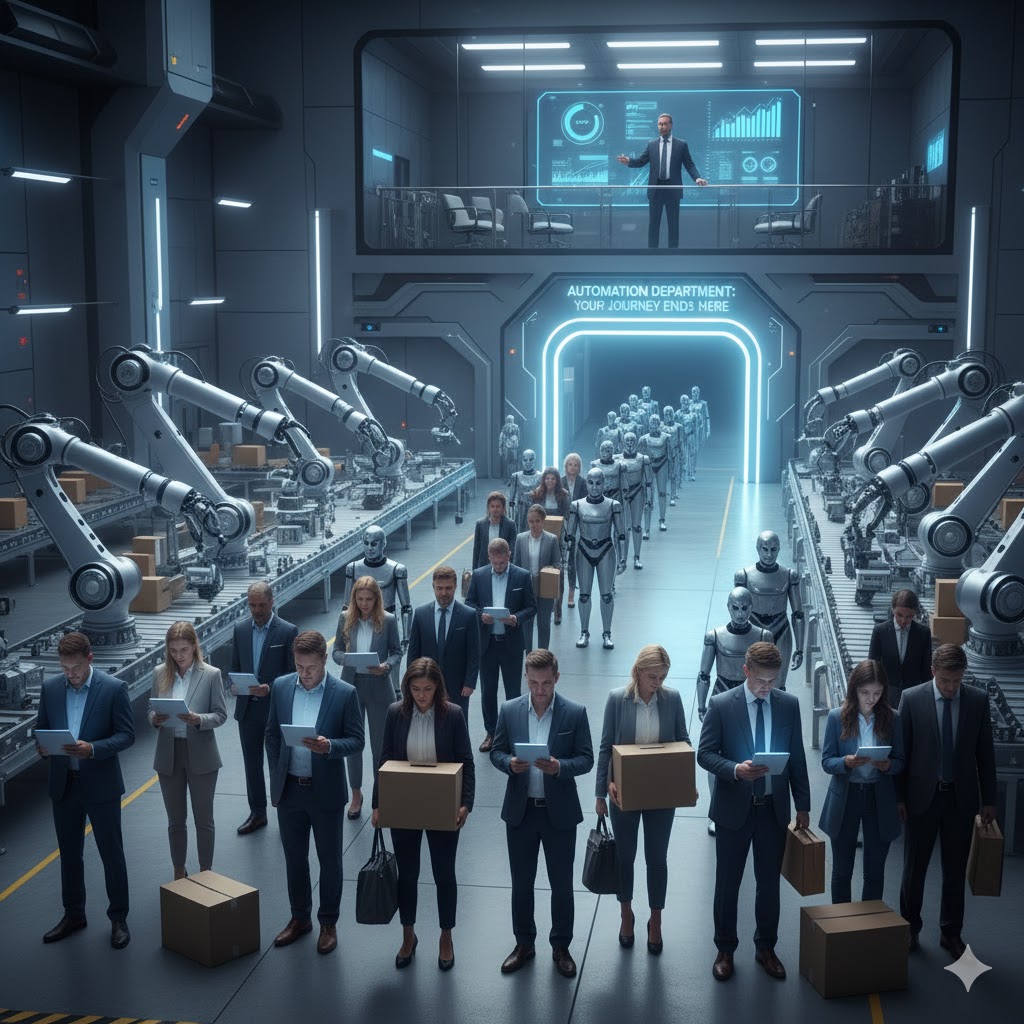
AI Leadership & Business Automation: The Human Trust Factor
The Enthusiasm of the Leap
There is a particular kind of enthusiasm that accompanies every technological leap. It is a sentiment that arrives early, speaks with a loud, unearned authority, and frequently mistakes the sheer velocity of a tool for a genuine understanding of its impact. Artificial intelligence is merely the latest recipient of this misplaced fervour. In boardrooms, strategy sessions, and media headlines, AI is being framed as both a definitive solution and an unavoidable inevitability. It promises efficiency at a scale previously unimagined; it promises competitive advantage in an increasingly crowded market. Most seductively, it promises the ability to do more, faster, and with fewer people involved.
That promise is alluring. It is also fundamentally incomplete. What is most striking about the current conversation is not the volume of what we are saying about the technology itself, but the profound silence regarding the people expected to live alongside it. In our rush to adopt tools that can think, predict, and generate, we have seemingly forgotten a foundational truth: businesses are still built, sustained, and ultimately trusted by human beings. Unless, of course, the customer has also been replaced by an algorithm, the human element remains the only true arbiter of value.
Progress Has Always Been Uneven
Technological progress has never been kind in a neutral or democratic fashion. It is a selective force that rewards those with the foresight to adapt, while quietly and often ruthlessly erasing those who do not. History is littered with the remnants of industries that believed they were indispensable. There was a time when entire global economies depended upon horse-drawn transport. This was an era of profound craftsmanship; men built carts by hand, and families earned their living from the mastery of wheels, wood, and harnesses. This work was not merely labour; it was skilled, respected, and stable.
When the automobile arrived, it did not seek permission or offer a grace period for adjustment. Some businesses disappeared almost overnight, unable to reconcile their old methods with a new reality. However, others survived by doing something far more difficult than resisting change: they reimagined their relevance. They transferred their deep-seated understanding of movement, mechanics, and durability into an entirely new industrial context. The difference between those who fell and those who thrived was not foresight alone. It was a fundamental willingness to see technology as an extension of human capability rather than a wholesale replacement for it. That lesson remains acutely relevant today as we stand on the precipice of the AI revolution.

What AI Can Do And What It Cannot
We must be objective about the capabilities of these new tools. AI excels at pattern recognition, speed, and scale. It processes information at a rate that no human team, regardless of their expertise, could ever hope to match. It reduces friction in systems that were once bogged down by slow, manual processes. In many cases, it improves accuracy and lowers the cost of entry for complex tasks. These are real, tangible advantages, and to ignore them would be strategically irresponsible.
But there is a threshold that AI cannot cross. It does not carry judgment in moments of high ambiguity. It does not possess the capacity to build trust over time through shared experience. It cannot "read a room," sense the subtle onset of team fatigue, or understand the complex emotional reasons why a once-capable employee has suddenly gone quiet. Most crucially, AI cannot hold moral responsibility. When outcomes affect livelihoods, reputations, or the stability of communities, the tool remains a tool; it cannot answer for the consequences. Those functions still belong—and must always belong—to people. The danger we face is not that AI will become more capable than us, but that leadership will become less accountable by outsourcing its core responsibilities to tools designed only to optimise, never to empathise.
The Quiet Cost of a Tech-First Mindset
When AI is introduced into an organisation without sufficient context or care, it rarely feels like innovation to those most affected by it. Instead, it feels like a signal often unspoken, yet deafeningly loud that human contribution is now merely provisional. People do not resist technology because they fear the act of learning. They resist it because they fear being made irrelevant without dignity.
When that fear takes root within a company, trust begins to erode. Engagement follows shortly after. Performance declines, not because the tools are ineffective, but because the human system surrounding them has been destabilised. Culture does not collapse with a loud bang; it withdraws into the shadows. Once that withdrawal happens, no amount of automation or algorithmic efficiency can restore what has been lost. The cost of a tech-first mindset is the slow, quiet bankruptcy of the organisation’s soul.
Scale Without People is Fragile
There is a growing, yet flawed, belief that scale is primarily a technological problem—that if our systems are efficient enough, the culture will simply take care of itself. Experience suggests otherwise. Organisations that attempt to scale without investing in leadership depth become fundamentally brittle. They look impressive on a spreadsheet until the first sign of pressure arrives. When markets shift unexpectedly, when crises emerge, or when trust is tested, it is not the systems that respond; it is the people.
Leadership, in this sense, is not about choosing between innovation and humanity. It is about the difficult task of holding both simultaneously without collapsing into extremes. The most resilient organisations are not those with the most advanced tools, but those where the people understand why the tools exist and how their own roles evolve alongside them.
The Question We Are Avoiding
The most important question facing leaders today is not whether AI will transform the landscape of business. That outcome is already well underway. The real question is this: will leadership evolve at the same pace? Technology can scale operations, but only people can scale judgment, ethics, and trust. When leaders fail to recognise this, they do not create future-ready organisations; they create efficient systems with no moral centre. And history shows us that those systems rarely endure.
The future does not belong to those who worship technology, nor to those who resist it out of spite. It belongs to leaders who understand that progress is relational as much as it is technical. AI should reduce friction, not responsibility. It should expand human capacity, not replace human relevance. Used well, it is a powerful ally; used carelessly, it is an accelerant for disengagement. The irony of our time is that as our tools become more powerful, the need for human leadership becomes more pronounced, not less.


